Slanker's Grass-Fed Meats

Grass-Fed Beef | Grass-Fed Lamb | Grass-Fed Goat | Grass-Fed Pork | Grass-Fed Bison/Buffalo | Pastured Poultry | Grass-Fed Dairy | Wild Ocean Fish | Grass-Fed Pet Food | Condiments | Health Supplements | Seasonal | Grassfed Meats | SHIPPING INFORMATION
Slanker's:
The Internet Store for Wild Salmon!
Have you signed up for our award winning newsletter?

The foundation food for Wild Fish and all Grass-Fed Meats is the Green Leaf. Click here to see why Man is an Extension of the Green Leafy Plant.
Slanker's Grass-Fed Meats
Your Healthy,
Nutritious, Delicious
Grass-Fed Meat Source!
Our e-mail address is:
Toll Free Number:
866-SLANKER (752-6537)
Local Number:
903-732-4653
Our time is:
3255 CR 45400
Powderly, TX 75473
near Paris, TX
Perfect for the
Real Diet of Man, commonly known as the Paleo Diet, the Hunter Gatherer diet, or the Caveman diet.
Grassfed is best!
Wild Ocean Fish
Slanker's has two meat stores.
This is part of the Ranch Store. There is also an Online Store.
Check them both out to see which one works best for you.
Slanker's Offers Only
the World's Finest Quality Seafood.
It is Wild, Ocean-Caught, Alaskan!
Salmon -- IN
Halibut -- IN
Pollock -- IN
King Crab -- OUT
Dungeness Crab -- OUT
Snow Crab -- IN
Pacific Ocean Alaskan Wild SalmonPremium Boneless Sockeye Wild Salmon Fillets with skin on
$14.98 per pound -- IN
Most Salmon Fillets weigh between 1.5 to 2.2 pounds.
Premium Boneless Sockeye Wild Salmon Three-Portion Packs
$15.38 per pound -- IN
Most Salmon Three-Portion Packs weigh 1.1 to 1.2 pounds.
Premium Smoked Sockeye Salmon Portions
$26.78 per pound -- OUT
Most Smoked Salmon Packs weigh about 0.25 pound.
Our Smoked Salmon is not moist because no ingredients (phosphates, etc.) are added to retain water.
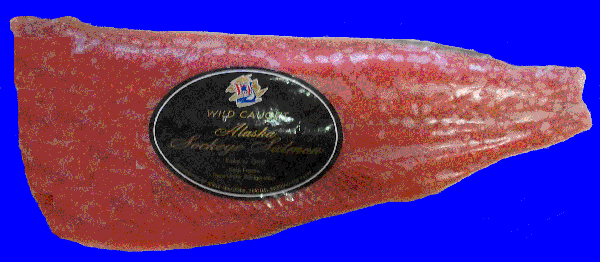
Here is a picture of a 19"-long fillet as
it appears in its vacuumed sealed packaging.
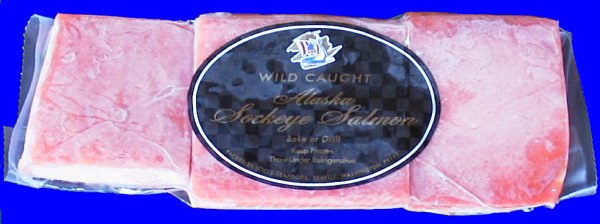
Here is a picture of a (frosty) 10"-long wild Sockeye steak pack
as it appears packaged in its vacuumed sealed package.
_________________________________________________
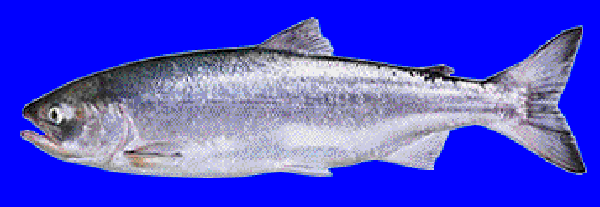
Sockeye (Oncorhynchus nerka)
Blue-tinged silver in color, sockeye salmon live four to five years, weigh up to 7 pounds, and are the slimmest and most streamlined of the five species of Pacific salmon. It is the most sought-after salmon species due to its rich flavor and firm, deep red flesh.
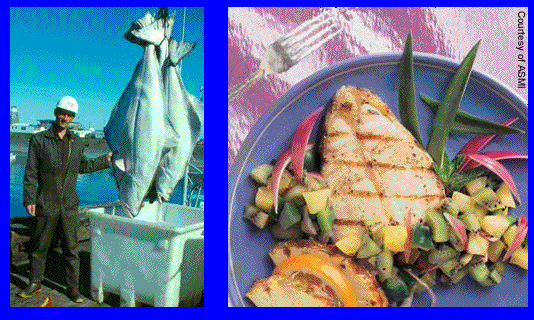
Wild Pacific Ocean Alaskan Halibut Halibut is the largest flatfish in the world; it can grow up to nine feet in length and weigh several hundred pounds. Its firm white flesh has a delicate mild flavor that lends itself to a variety of recipes. Our halibut is sold flash frozen fresh and comes in steaks that weigh about eight ounces. Alaska halibut are harvested from early March until mid November each year with the fishing grounds stretching from Northern California to the tip of the Aleutian Chain to almost Nome, Alaska.
Premium Bone-In Halibut Steaks.
Halibut Steaks weigh from 0.4 to 0.6 pounds.
$19.98 per pound -- IN
10 Pound Packs are $19.48 per pound -- IN
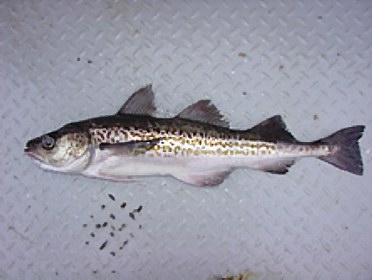
 Wild Pacific Ocean Alaskan Pollock
There are two main species of commercial importance, the Alaskan and Atlantic pollock. The pollock are members of the cod family. Alaska pollock is also known as walleye pollock. Alaskan pollock is the world's most abundant food fish. They are relatively small fish that weigh between 230 and 900 g ( 0.5-2 lbs). Pollock is a white fish, so it isn't too strong. If you like sole or cod or haddock, you will like pollock.
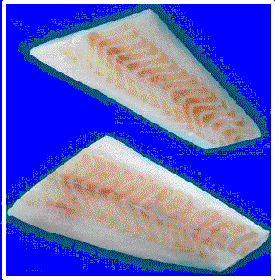
Premium Boneless, Skinless Pollock Fillets
Most Pollock Fillet packs contain three fillets and weigh between 1.2 to 1.5 pounds.
$5.98 per pound -- IN
10 Pound Packs are $5.48 per pound
 |
 |
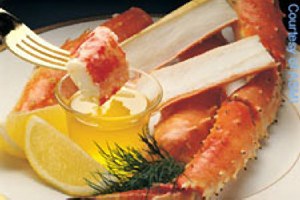
Wild Pacific Ocean Alaskan King Crab No other shellfish in the world projects a more elegant image or offers such widespread consumer appeal than Alaska King Crab. It is unmatched for its sweet flavor and rich, tender texture. It truly deserves its title, “King of Alaska.” There are usually 12 to 14 King Crab legs per 10-pound box. On average the legs weigh about 0.77 pounds (12 ounces). That means there are about three legs in a "2-pound" pack.
Premium King Crab Legs and Claws are OUT
$23.98 per pound in 2-pound Packs
10-Pound Packs are $21.98 per pound
 Wild Alaskan Dungeness Crab Clusters
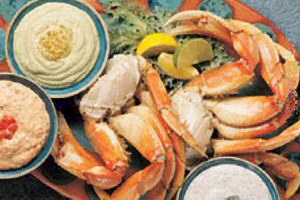
 Alaska Dungeness Crab has been a tradition on the West Coast for decades. Prized for its distinct mild flavor and firm texture, it's a favorite at picnics and barbecues where the term "cracked crab" really means something. It's famous for being the key ingredient in Crab Louie salads!
Premium Dungeness Crab Clusters
$12.88 per pound in 2-pound Packs - OUT
10-Pound Packs are $11.48 per pound - OUT
 Wild Alaskan Snow Crab
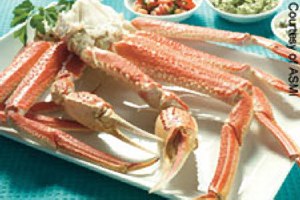
 Alaska Snow Crab is one of the most unique, flavorful, and popular shellfish items you can eat. Noted for its sweet, delicate flavor and snowy white meat Snow Crab is a popular menu item in buffets as well as a profitable signature item in discerning restaurants.
Premium Alaskan Snow Crab Clusters
$10.78 per pound in 2-pound Packs - IN
10-Pound Packs are $10.28 per pound - IN
Seafood Preparation
Of course, crab is always precooked ("boiled at the dock") and is not sold fresh. This is why the shell has a red color. Therefore all one has to do to the crab is warm it up if they want to serve it hot. In terms of food safety, the industry recommends that the exterior be warmed to a temperature of 160 degrees.
The best way to thaw seafood is to leave it overnight in the refrigerator. Allow 8 to 10 hours. (Extremely large cuts/fish may take a bit longer.) Do no try to speed up the process of thawing seafood. Never thaw seafood at room temperature or place directly in warm water -- flavor and texture are both lost this way.
Imagination is the only limitation when preparing Wild Ocean Seafood and Alaska Salmon and Halibut are no exceptions. Try baking, broiling, barbecuing, or grilling with lemon, onion, and a little butter. Just remember not to overcook! A general rule of thumb is to cook about 10 minutes per inch of thickness, measuring fish at its thickest part, or until seafood flakes when tested with a fork. Preheat oven to temperature 350°F. Arrange the salmon skin side down in a lightly oiled (Macadamia Nut oil) baking dish. Sprinkle chopped onions over fish. Drizzle with melted Pastured Butter. Season to taste with pepper. Serve with lemon wedges.
Now a quote from the National Fisheries Institute:
Important Information About "Farmed" Salmon
Much of the salmon we find in supermarkets and restaurants is farmed Atlantic salmon.
Scientists and health professionals encourage consumers to eat fish, like salmon, twice a week because of the health benefits of Omega-3s, which studies have shown may help prevent heart disease. You can purchase salmon caught in the wild or farmed. Both are nutritious and delicious, containing an ample supply of omega-3s.
Farmed salmon, also called cultivated or aquacultured, are raised in large, floating enclosures in the cold, coastal waters of the United States, Canada, Chile, Iceland, Norway and the United Kingdom. Salmon farmers use modern techniques to ensure the health of their stocks, limit waste in the ocean, and prevent accidental escapes of farmed salmon that might interbreed with wild salmon. They use government-approved antibiotics to treat their salmon when necessary, and ensure that the salmon are not harvested until the antibiotics leave their systems.
Salmon farmers feed their fish with pellets made from fish meal or oil, cereals such as corn or soy, and vitamins. Farmers use only the amount of feed needed to grow the salmon to market size. The salmon feed also contains tiny amounts of natural or synthetic canthaxanthin, which is an important nutrient for the salmon and gives it a pink color. Wild salmon get this color from eating shrimp and krill. FDA requires that farmed salmon be labeled as having artificial color because of the color's addition to the feed, but the fish is not injected or dipped in any way. And salmon sold in the United States must meet the Food & Drug Administration's regulations on food safety.
Here's an interesting quote from The Catfish Institute:
Quality-Controlled Environment - U.S. Farm-Raised Catfish are raised in clay-based ponds filled with pure, fresh water. In these clean, man-made ponds, the fish are fed grain-based pellets, comprised mostly of soy and corn, which float to the top of the water.
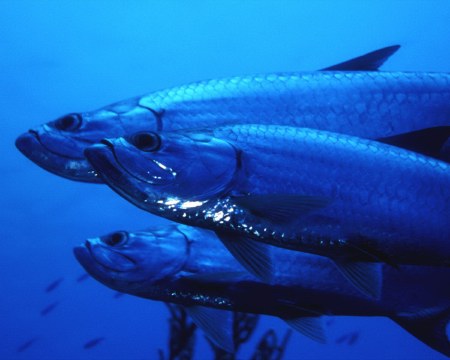
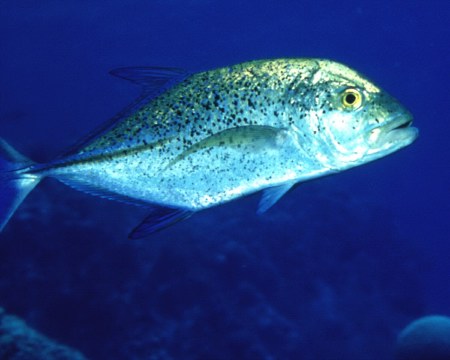
In comparison to farmed fish -- wild fish need no such explanation.
For a report published in Environmental Science & Technology titled "Lipid Composition and Contaminants in Farmed and Wild Salmon" -- click here.
Copyright 2000-2014 © Ted E. Slanker, Jr., All rights reserved.